


Inequality in Korea
| For some strange reason, "inequality" is one of the words of the English language that always escapes my mind when I need to write it (or use otherwise). Also now I had to look it from pulpyôngdûng in the dictionary. But this is not the main point of this note, not even a starter. Inequality is a continuous issue in South Korea, no matter what the developments of democracy and distribution of wealth are. Phrases like pinikpin puikpu (貧益貧富益富, poor getting poorer and rich getting richer) or yujôn mujoe mujôn yujoe (有錢無罪無錢有罪, innocent if rich, guilty if poor) are constantly given new life, not the least since the late 90s' economic crisis and the changed social and economic landscape since. Korea Institute for Health and Social Affairs has recently surveyed about the Koreans' perceptions of equality and inequality in the society, and not surprisingly, the general view is that the inequality is severe and only increasing (reported in Pressian). I'll finish this note later, and for now I just link a table from the Pressian article about the perceptions of inequality of wealth, divided to three income strata: low-income, middle class, and high-income. 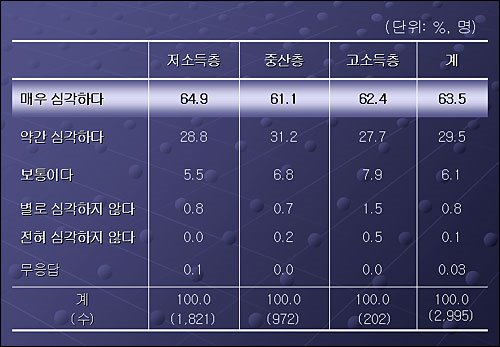 (c)Ministry of Health and Welfare, via Pressian Categories at del.icio.us/hunjang: stratification ∙ money ∙ Koreansociety |
Antti Leppänen, 2:02 PM  │
│
│
│
│
│
Comments to note "Inequality in Korea" (Comments to posts older than 14 days are moderated)
Write a Comment