<$BlogRSDURL$>
Reading

Hannu Salama: Kosti Herhiläisen perunkirjoitus
Flickr photographs
www.flickr.com
More of my Flickr photos
∙ Current position: Academy of Finland Postdoctoral Researcher, Social and Cultural Anthropology, University of Helsinki
∙ Ph.D. dissertation Neighborhood Shopkeepers in Contemporary South Korea: Household, Work, and Locality available online (E-Thesis publications a the University of Helsinki). For printed copies, please contact me by e-mail.
Contact ∙ Personal
∙ cellular ∙ mail ∙ my del.icio.us bookmarks
∙ my photographs at Flickr
∙ Anthropology at U. of Helsinki
∙ Finnish Anthropological Society
Powered by Blogger

Anthropology, Korean studies and that

∙ Savage Minds
∙ Keywords
∙ Golublog
∙ photoethnography
∙ antropologi.info
∙ Solongseeyoutomorrow
∙ Constructing Amusement
∙ Otherwise
∙ Frog in a Well

Often visited

∙ The Marmot's Hole ∙ Gusts Of Popular Feeling ∙ Sanchon Hunjang ∙ Mark Russell ∙ Language hat ∙ Muninn ∙ gyuhang.net ∙ Sedis ∙ Kemppinen ∙ Jokisipilä ∙ Panun palsta
Weblog Commenting and Trackback by HaloScan.com


Google this blog
∙ Download Hangul Viewer 2002
∙ Download Hangul Office Viewer 2007

Archives

∙ December 2003 ∙ January 2004 ∙ February 2004 ∙ March 2004 ∙ April 2004 ∙ May 2004 ∙ June 2004 ∙ July 2004 ∙ August 2004 ∙ September 2004 ∙ October 2004 ∙ November 2004 ∙ December 2004 ∙ January 2005 ∙ February 2005 ∙ March 2005 ∙ April 2005 ∙ May 2005 ∙ June 2005 ∙ July 2005 ∙ August 2005 ∙ September 2005 ∙ October 2005 ∙ November 2005 ∙ December 2005 ∙ January 2006 ∙ February 2006 ∙ March 2006 ∙ April 2006 ∙ May 2006 ∙ June 2006 ∙ July 2006 ∙ August 2006 ∙ September 2006 ∙ October 2006 ∙ November 2006 ∙ December 2006 ∙ January 2007 ∙ February 2007 ∙ March 2007 ∙ April 2007 ∙ May 2007 ∙ June 2007 ∙ July 2007 ∙ August 2007 ∙ February 2008 ∙ March 2008 ∙ August 2008 ∙ January 2009 ∙ February 2009 ∙ January 2010 ∙ February 2010 ∙ March 2010 ∙ January 2011

Friday, January 26, 2007

Hanchongnyon leader interview in Daily NK

Daily NK has an interesting interview of Mr Ryu Sang-min, the head of Chonnam National University student union and a strong candidate for the next chairperson of Hanchongnyon. These views - taking unconditionally side with the DPRK government - are nothing new, but it is nice to see them in such a condensed form. The hasty translation is mine. (Update: some expressions have been corrected for better English, following Robert's translation snippets at The Marmot's Hole.)
You used the expression "nuclear-owning people" (haekpoyu minjok). What do you mean by that? (The interviewer refers to what Ryu said in a "New Year's Joint Struggle Proclamation.")
- North Korean nuclear [weapons] must be seen from the perspective of our nation (minjok). The possession of nuclear weapons in not aimed at the South. It's clear that nuclear weapons are not used against the same people. North's nuclear weapons are the consequence of the 62 years of USA's sanctions and attempts to overthrow their system and government. North Korea developed nuclear weapons for self-defense. It's because of USA that has attempted to crush the dignity and self-determination of North Korea. The nuclear weapons prevent war for our whole nation (uriminjok, "our nation", "our people", "our race"). North Korea's ability to prevent war keeps peace in the Korean peninsula and lets us live free from worry.

Your opinion of the North Korean Military First policy (sôn'gun chôngch'i) is very positive.
- Because of the Military First policy the peace in the Korean peninsula can be protected and the danger of war prevented. Because of North Korea's strong war deterrent, USA and other foreign powers (oese) can't mess with the Korean peninsula so easily. When in 2003 USA was going to attack Iraq it was said that it was because of weapons of mass destruction, but actually they were able to attack because there were no such weapons. If there was no military first [policy], it's possible that the Korean peninsula would face what happened in Iraq.
The role of military first is big in preventing USA's frantic plans of toppling North Korea['s government] and establishing a pro-American government.

Aren't you presenting purely the North Korean view?
- This is about preventing the dangers faced by the Korean peninsula, not about following the Northern system and politics unconditionally. Media is condemning us by claiming that we act on the orders of North Korea. We are concerned because the terminology [concerning military first policy] is used in a negative sense.

Why do you emphasize the struggle against Grand National Party?
- The presidential election takes place in 2007, and the fate of the nation depends on who gets elected. Bellicose statements such as "the problem of North Korean nuclear weapons must be solved even if there's a danger of war" prevent the unification and peace of the Korean peninsula. Therefore, we have declared struggle against Grand National Party [GNP] in the presidential election.
This year's election is not simply a contest of policies and pledges but a war (chônjaeng) between the forces of peaceful unification (p'yônghwat'ongil seryôk) and the fascist forces of the past (kwagô p'asyoseryôk). Since GNP has lost two presidential elections they'll fight hard to take the power. GNP's schemes uncompatible with the June 15 era must be stopped.

Do you see GNP aiming to return to the dictatorship of the past?
- GNP, regarding North Korea as enemy and the June 15 declaration as national discrace is an anti-masses(panminjung), anti-unification force.

What do you think about the serious breaches of human rights in North Korea?
- I can't understand the talk about North Korean human rights problems. USA is pointing out human rights problems in North Korea, but USA's breaches of human rights are more serious. How many people in the big land mass of USA are able to live and hold up human rights?
There are several North Korean human rights organizations in our country as well, but the violations of human rights in South Korea are also very severe. The Southern part is no different in regard to human rights. Human rights are a question of the system of the society. People in North Korea must feel it in order to have a problem, it's not something to be defined by outsiders.

Isn't the North Korean human rights situation too horrible to be compared with South Korea?
- Where's the proof? North Korean refugees say there are human rights problems, but they can't be believed. US human rights organizations' covert operations (kongjak) make North Korean refugees tell lies. USA gives all kinds of funds to human rights organizations and has them operate along the Chinese border and scheme "unwilling" escapes from North Korea. We must listen to the opinions of people living in North Korea and not the refugees. I went to the Kumgang Mountains and met North Koreans (Pukhan tongp'o) there. I didn't hear them say that there are human rights problems [in North Korea].

So do you mean that there are no human rights problems in North Korea?
- We must correct our perspective on human rights problems. People living in North Korea are proud of the Military First policy, and if they think that it's ok to have less to eat and wear in order to defend that policy, then the consequently arising problems can't be regarded as human rights problems.


Categories at del.icio.us/hunjang: ∙ ∙

Wednesday, January 24, 2007

Spam from ROK embassy in US

Every now and then I receive mail from Korus, the Embassy of the Republic of Korea in the United States, from an address under the domain dynamic-korea.com. It's not surprising that a person involved in Korea-related research ends up in such e-mail lists; the annoying and almost unforgivable (and detrimental to the aims of those mailings) is the fact that when I've tried to get myself removed from the mailing lists and have the mailings cancelled (especially as events in the USA have little relevance for me), all the contact e-mail addresses given in the messages or in the homepage(feedback@dynamic-korea.com, webmaster@dynamic-korea.com) bounce. Perhaps I should file a complaint to the Korea Information Security Agency (www.spamcop.or.kr).

Categories at del.icio.us/hunjang: ∙

Friday, January 19, 2007

Trying out Flickr (some panoramas)

Seems that I'll have to find another web photo service to upload my vast number of panorama shots I took in Korea. For example this panorama shot of the western part of Jinhae, with the original size of 8571 x 1625, doesn't look that impressive when it is reduced to 1024 pixels in width in Flickr.


Jinhae panorama
Originally uploaded by Anttinen.
Update: click this link to see a 3692x700 pixel (624K) version of the picture.

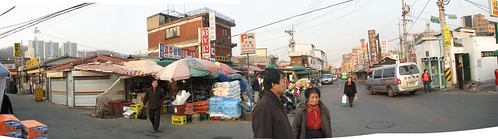
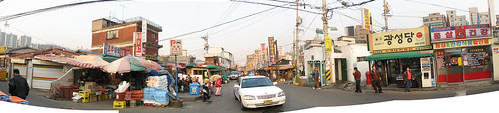
Sillim 6-dong marketplace, Seoul
(Update: click this link to see a 2511x700 pixel (624K) version of the picture.)
These two are from Sillim 6-dong marketplace in Seoul. This location belongs to the area to be developed as "New Town" (my note from April 2006). According to the official announcement of the Gwanak-gu administration (to which Sillim belongs), the construction is supposed to begin this month (January 2007), so these pics just may end having some historical value, but it wouldn't be the first time a development project is delayed.
Neighborhoods like this are photogenic, mainly because of the ideas of "humaneness" or "human flavor" that people like me have learned to associate with this kind of sceneries as compared to apartment block areas. (I'll have a post coming of what it looks like in Nan'gok now that the apartment block construction is finished; here are my pics of what it looked like there in 2000 and in 2001-2002.)
Sillim 6-dong marketplace, Seoul
(Update: click this link to see a 3093x700 pixel (421K) version of the picture.)
Categories at del.icio.us/hunjang: ∙ ∙ ∙

Thursday, January 18, 2007

한국 갔다 와서 (피 똥 오줌)

The title is in Korean because I could not think how that can be put as neatly in English. ("After visiting Korea"?) During the three-week visit, I was healthy only for one week; first it was the piece of rice cake (ttôk) that I left on the motel room table and did not put in the fridge that made me sick. I recovered from that quickly only to catch a nasty cold which continued for the rest of the visit and even after returning, giving me recurrent strokes of fever among other things. Because my fever was as high as 39.3 on the evening of the second day back in Finland, I went to see a doctor, who sent me for further examination as the blood test showed a very high infection level (CRP?), over 200. The longer I sat in the hospital corridor after seeing a doctor and giving new blood samples the more miserable the state of public health care looked like and the better the idea of escaping the place altogether appeared. I checked in at 1 pm, and at 8pm a doctor came to inform me that the infection level had gone down so much that I could go home, on the condition that I return the next day to give new samples. He also noticed that no urine and feces tests (the parenthesized part of the title refers to this) had been taken even though they were clearly marked in my papers. I felt like cursing no voi perkele. The three visits to that hospital during the week hardly contributed to my recovery, which in the end took place without antibiotics (which was a good thing in itself, of course).

• As for the visit to Korea, most of the time - quite naturally - we spent among my wife's family in Jinhae, Changwon, and Busan. (People whom I meet after a long time tell that it shows in my accent. Heck, it might even show in the way I speak Finnish.) Even though my parents-in-law's house is not, how shall I put it, up to contemporary standards (and it can be felt especially in the winter), I couldn't have perhaps spent a better time. For example my wife's younger sister's (ch'ôje daughters are at an age in which they wrap an imobu around their fingers at their will.
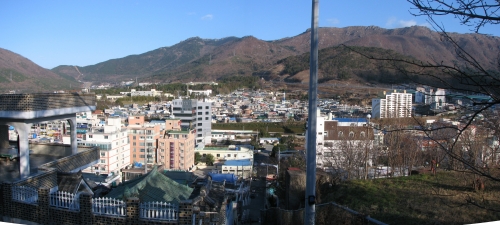
Western Jinhae, photographed from Jehwang hill. (Click for a bigger pic to open in a new window.) The old center of Jinhae is even more westwards from here, but recent developments in areas closer to Busan have rendered this part of town almost as underdeveloped, and shifted the commercial weight and population towards east. Also the present position of City Hall reflects this.


• I was happy to meet the people among whom I conducted research after a long time, and as far as I can tell the feeling was mutual, but I also got the feeling that the special relationship that enabled research is now over. (Actually, it's about time now that I'm finally to get the doctorate...)
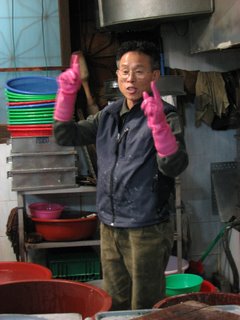
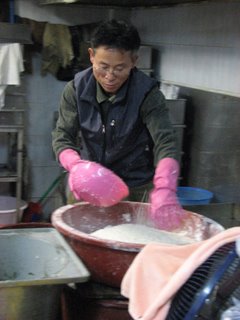
Mr Pak, the most important person for my research, was very busy in his rice bakery (ttôk pangakan) before Christmas, so I could exchange only the basic courtesies and news. Not surprisingly, he had moved to a newly built apartment in Sillim 7-dong (or was it 6-dong) meanwhile.


"Yumin's mother" operated her clothing repair shop as before. Her husband, who operated a "cramming dorm" (kosiwôn) for a while, was back driving taxi, now for a company before he can get his own private taxi.

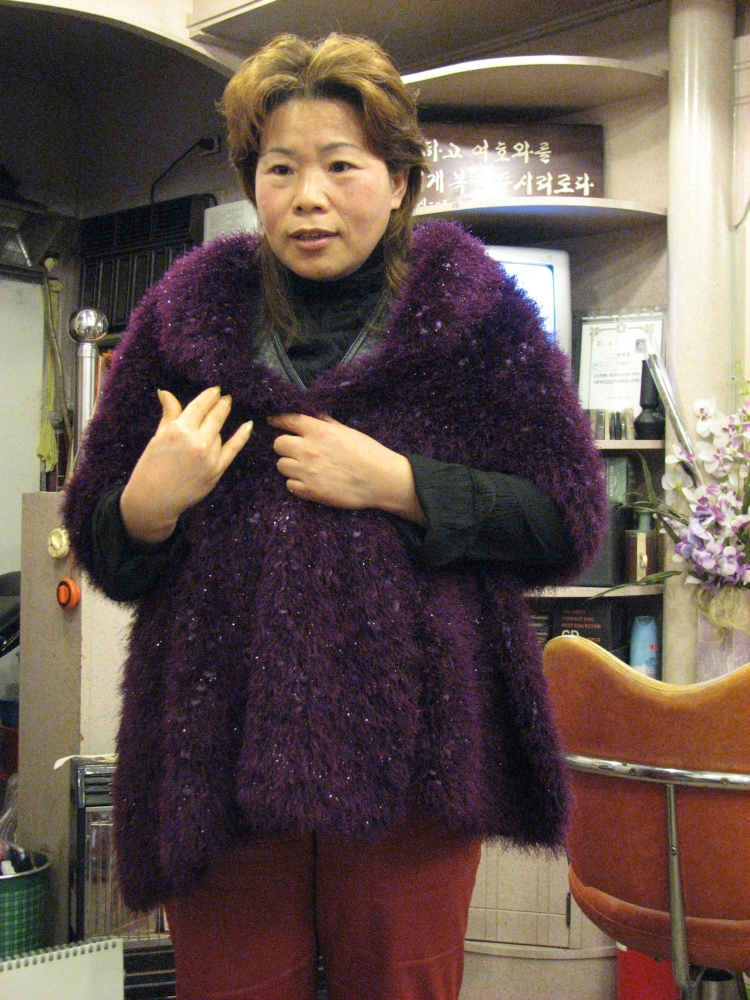
Hairdressing business is nowadays slow, at least in "Mrs Hong's" place. Her explanation makes sense: people's funds are so much tied to real estate that expenditures such as dressing one's hair are being cut.


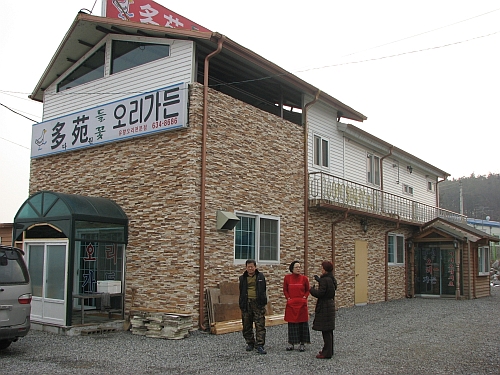
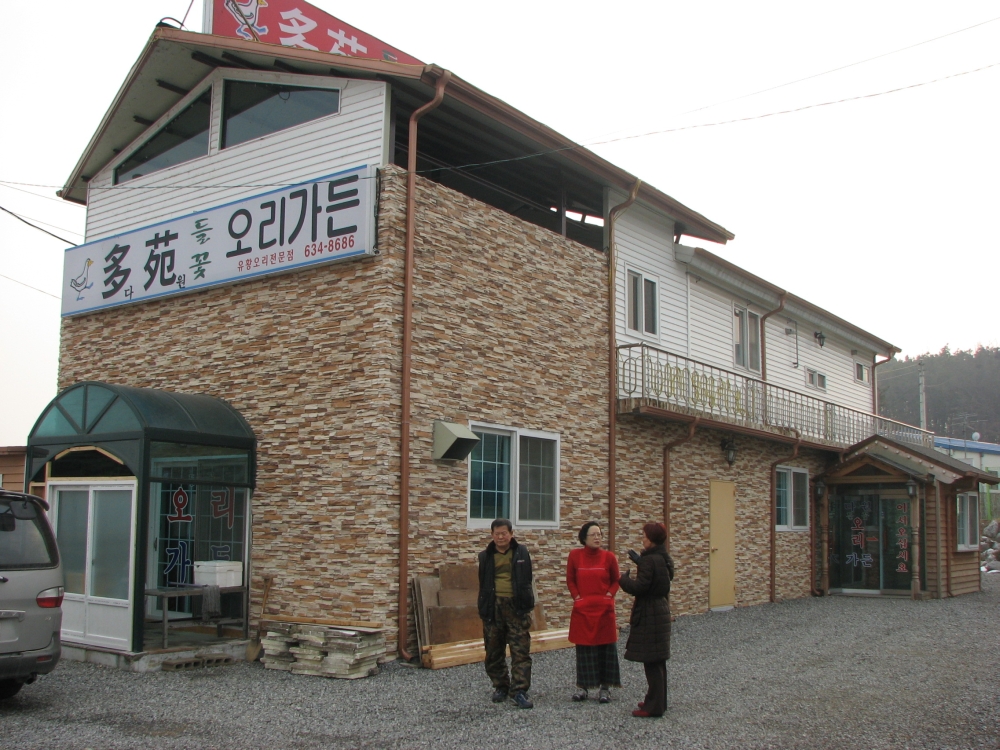
When "Mr Kim" and "Mrs Kang" were closing their restaurant in 2001 in the Sillim 2-dong neighborhood where I conducted research they said they were planning to open a restaurant somewhere in the countryside, specializing in a single dish. For a long time it didn't look as if they were going to realize their plan, but now it turned out that they had purchased a house in the rural parts of Icheon, Gyeonggi-do, living in the upper floor and operating a duck meat restaurant in the ground floor. It appears that despite of being in the middle of nowhere, there is enough clientele to sustain such a place, and the urban Icheon, a growing place and a prospective site for a "new town", is a 10-15 minute drive away.

Categories at del.icio.us/hunjang: ∙ ∙ ∙ ∙